In order for pharmaceutical organizations to create and maximize the future value of their assets, early lifecycle management needs to be approached with intentional design by laying out a clear pathway of value creation milestones. Among the most important of these milestones is indication expansion.
In case you missed it, in our previous article we introduced the concept of lifecycle pathways and discussed their components, architecture, and role in creating, expanding, and sustaining value over time. We recommend you explore this before we delve into how to design the optimal indication sequence.
Identifying attractive future indications is only part of the challenge for pharma teams. For assets with multiple development opportunities, organizations must also determine indication prioritization and sequencing over time. While the same set of indications may ultimately be pursued, the order and pace in which they are developed can significantly influence development risk, pricing flexibility, commercial efficiency, and long-term asset value.
At its core, indication sequencing is not simply about deciding what comes next. It is about determining how each indication can build momentum for those that follow, creating a cumulative effect that is greater than the sum of its parts. As a result, indication sequencing represents one of the most important architectural decisions within a lifecycle pathway.
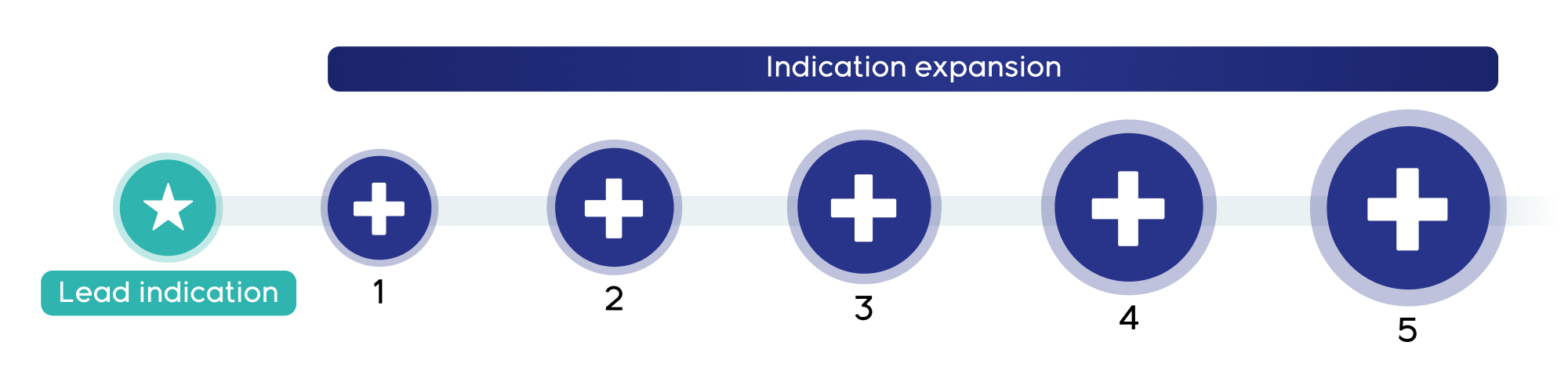
The challenge is that most organizations are already highly proficient at evaluating individual indications. Commercial opportunity, development feasibility, investment requirements, and strategic fit are often assessed in considerable detail.
However, these frameworks are designed to answer a different question:
“Should we pursue this indication?”
Indication sequencing requires organizations to answer an additional question:
“How do these opportunities fit together as part of a lifecycle pathway?”
Before organizations can design an indication sequence, they must first understand which opportunities are worth pursuing.
The First Step: Prioritize Individual Indications
Indication prioritization typically begins with establishing a broad indication universe and then systematically narrowing that universe to the opportunities most aligned with the asset’s mechanism, development potential, and strategic objectives. Once a manageable set of opportunities has been identified, each indication can be evaluated through a structured assessment of factors such as commercial attractiveness, probability of success, investment requirements, and strategic fit.
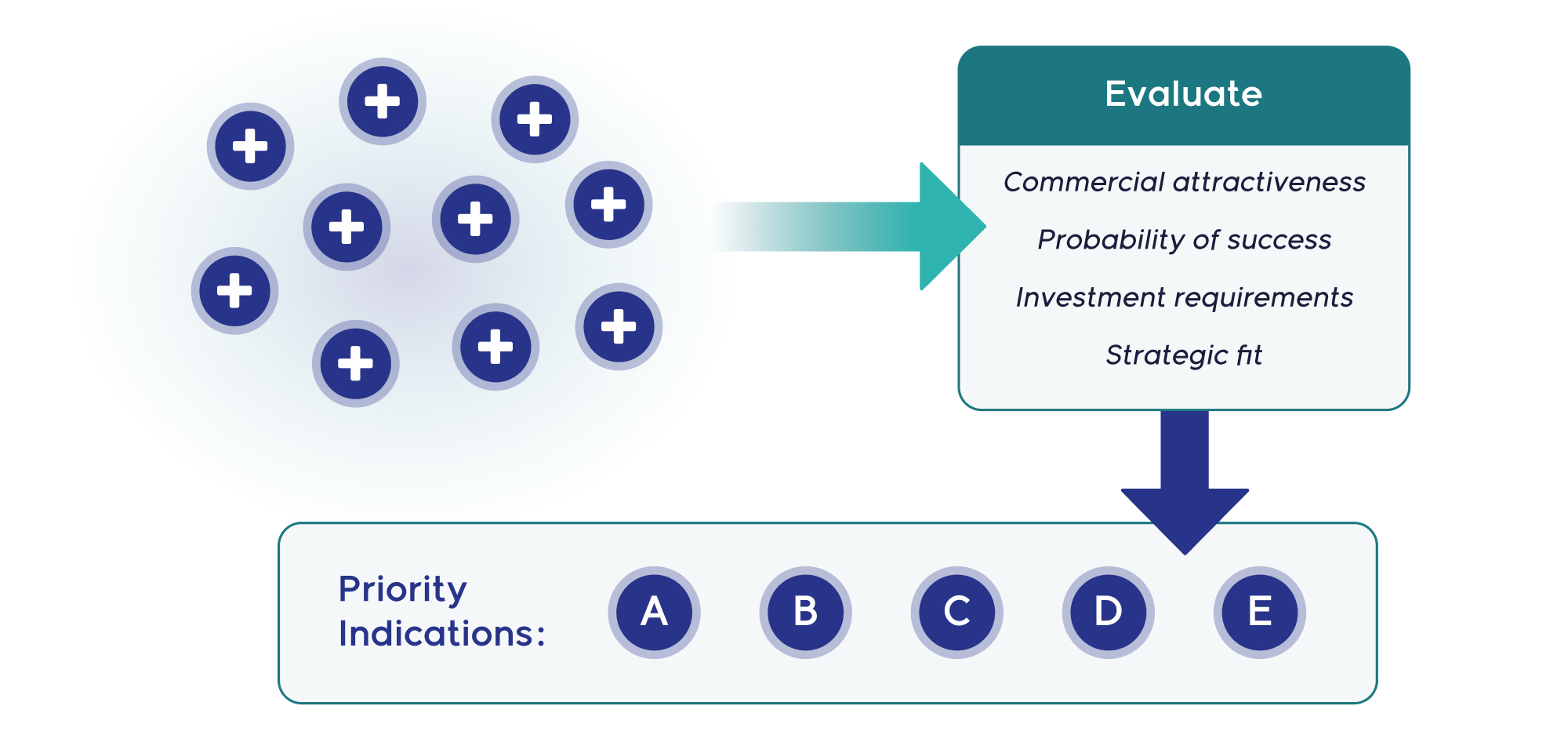
This indication-by-indication assessment remains an essential foundation for indication expansion planning. It helps organizations understand the relative strengths, weaknesses, and potential value of individual opportunities. However, indication prioritization alone does not determine the optimal indication sequence.
An indication that appears highly attractive when evaluated independently may not necessarily represent the best next step within a broader expansion strategy. Likewise, an indication with more modest standalone potential may create advantages that amplify the value of future opportunities.
Determining the optimal indication sequence therefore requires organizations to move beyond evaluating individual opportunities and begin assessing how those opportunities interact with one another over time.
Designing an Indication Sequence That Builds Momentum
Once a set of priority indications has been established, attention can shift toward designing the sequence itself. The objective is not simply to identify an order of execution. It is to determine how indications can be orchestrated in a way that builds momentum, creates leverage, and amplifies value across the broader lifecycle pathway.
Importantly, there is rarely a single obvious answer. A sequence optimized for speed may not be the same sequence optimized for certainty of outcomes. A sequence designed to maximize pricing flexibility may differ from one designed to minimize investment risk. Similarly, the optimal sequence for one organization may not be the optimal sequence for another, even when evaluating the exact same set of indications.
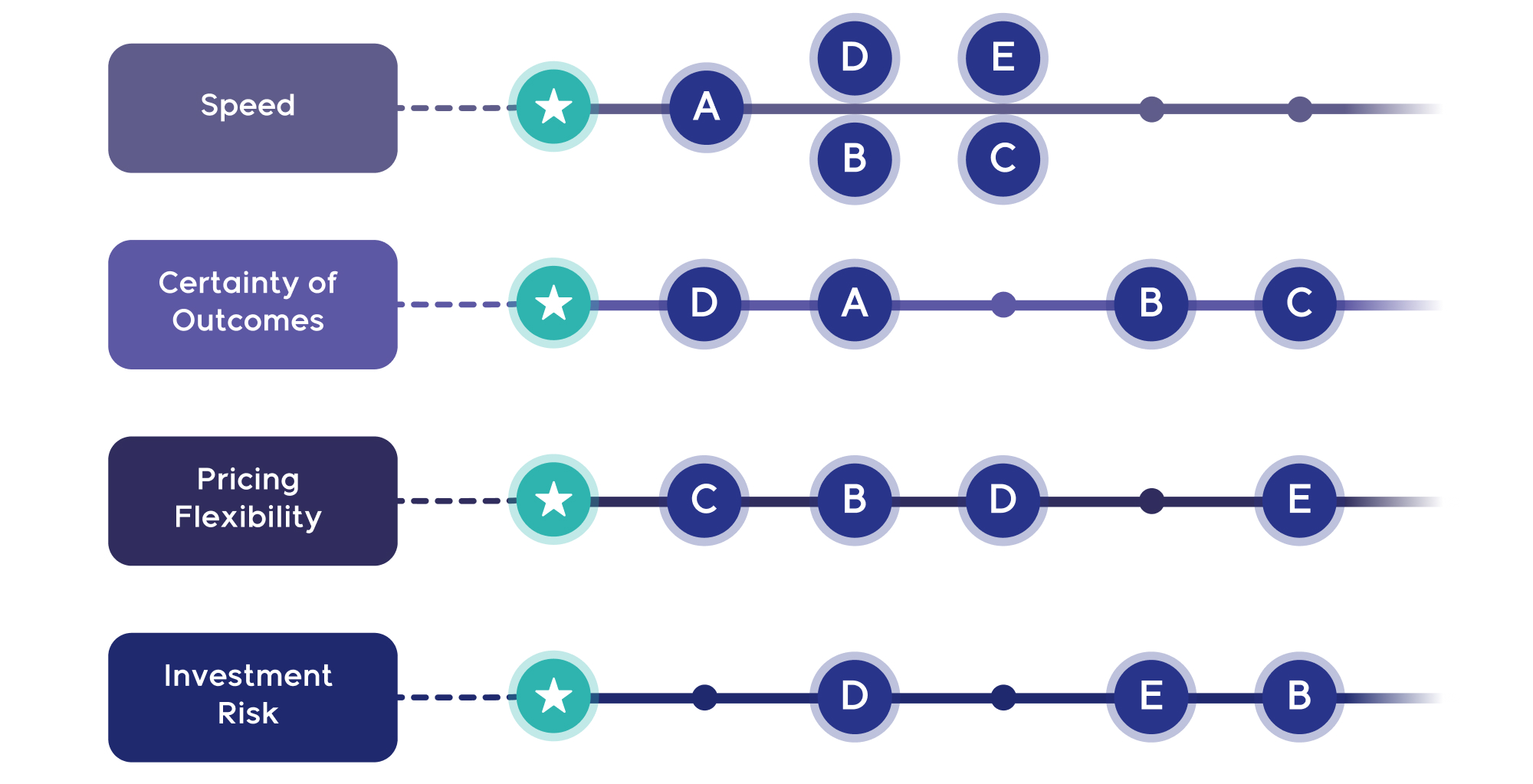
For this reason, indication sequencing should not be approached as a linear prioritization exercise. Instead, organizations should develop and evaluate multiple sequencing scenarios, assessing how each option supports the lifecycle objectives established for the asset and how effectively it contributes to the broader lifecycle pathway.
While every asset and organizational situation is unique, several recurring considerations often have an outsized influence on sequencing decisions.
1. Scientific and Regulatory Linkage
One of the most important considerations in indication sequencing is the degree of scientific and regulatory linkage between future indications. While indication expansion opportunities are often discussed as a collection of individual development programs, the reality is that some indications are much more closely connected than others. Success in one indication may strengthen confidence in the underlying biology, validate clinical endpoints, establish regulatory precedent, or generate evidence that can support future development efforts. In other cases, each indication may require a largely independent evidence package and carry a distinct risk profile.
When evaluating alternative sequencing scenarios, organizations should therefore consider two related questions:
- To what extent is success in one indication predictive of success in another?
- How much additional evidence will be required to support future expansion?
Together, these factors help determine the degree of linkage between indications.
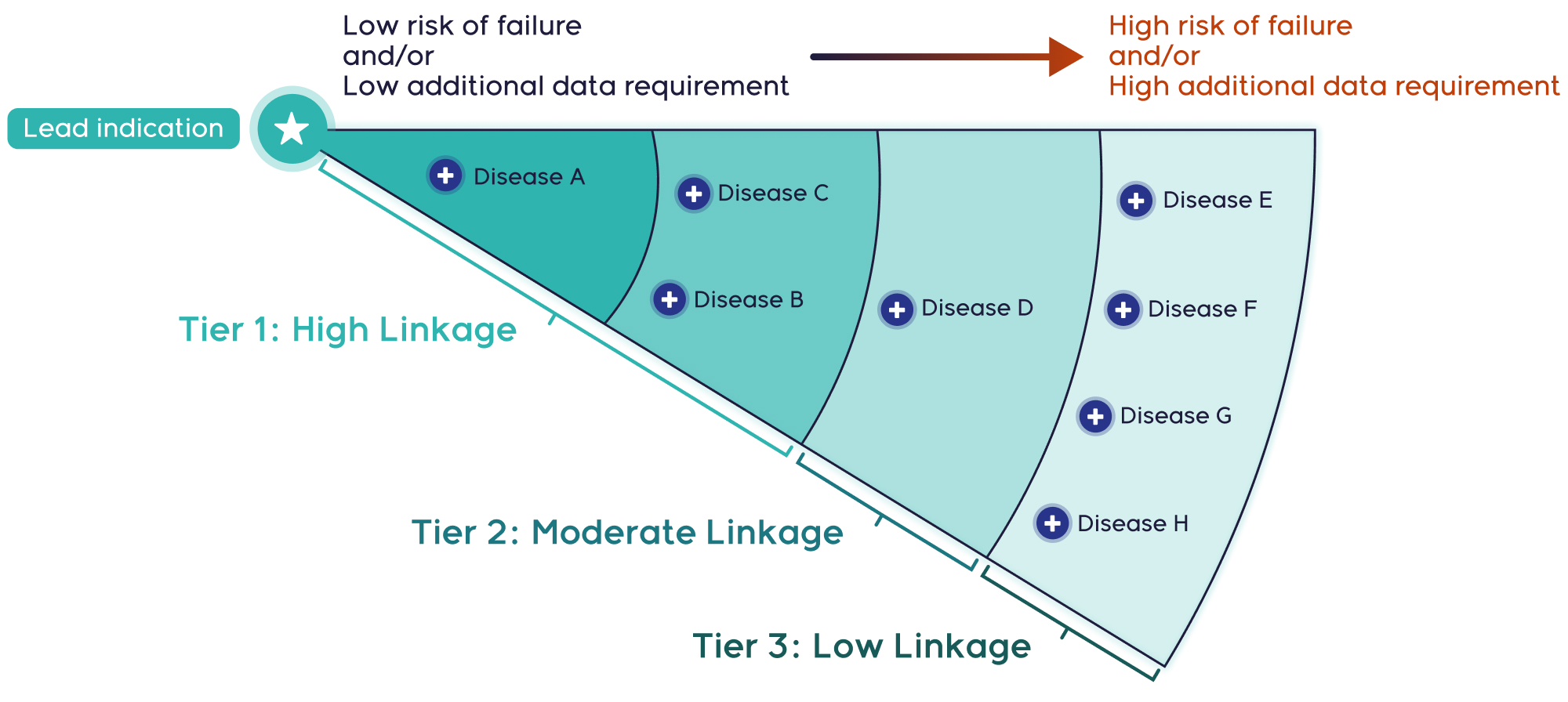
The degree of linkage can have a meaningful impact on sequencing decisions. Highly linked indications may allow organizations to leverage existing evidence, accelerate development timelines, and reduce uncertainty for future expansion opportunities. By contrast, indications with limited linkage may require substantial new evidence generation and provide relatively little predictive value for subsequent development programs.
For this reason, indication sequencing should not only consider the attractiveness of future indications, but also the extent to which those indications create a stronger foundation for the opportunities that follow.
2. Incremental Market Opportunity
When indications are evaluated individually, commercial potential is often assessed as if each opportunity exists in isolation. However, the value created by an indication can be heavily influenced by the indications that precede it.
In some cases, a future indication may unlock access to an entirely new patient population and create substantial incremental value. In others, the additional opportunity may be more limited than headline prevalence figures suggest.
Several factors can influence the true incremental value of a future indication:
-
Pricing and reimbursement implications:
The order in which indications are pursued can influence future pricing flexibility, reimbursement expectations, and the value ultimately realized from subsequent indications. For example, launching first in a rare disease indication may support a premium price point, but create challenges when expanding into larger populations with different standards of care and payer expectations. Conversely, launching first in a broad indication may facilitate rapid patient reach, but constrain pricing flexibility in future indications that might otherwise command a premium.
-
Existing off-label utilization:
In some settings, physicians may already be prescribing a therapy outside its approved label. In these cases, a formal indication may provide less incremental commercial value than prevalence estimates alone would suggest. For example, in an ultra-rare disease where physicians are already using a therapy extensively off-label, obtaining a formal indication may create less incremental commercial value than expected. Conversely, in settings where reimbursement or treatment guidelines restrict use to on-label indications, expansion may unlock substantial new patient access.
-
Degree of patient overlap between indications:
Future indications do not always represent entirely new patients. Organizations should consider the extent to which patient populations overlap and whether a new indication meaningfully expands the treated population or primarily extends treatment into patients who may already have received the therapy later in their treatment journey. For example, expansion from later-line to earlier-line treatment settings can increase the eligible population substantially, but may not create a proportional increase in incremental patients if many would have eventually received the therapy anyway.
As a result, the value of a future indication cannot always be evaluated independently of the indications that precede it. Organizations should therefore focus not only on total market opportunity, but also on the incremental value each indication contributes within the broader sequence.
3. Commercial Synergy
While indication linkage influences how efficiently indications can be developed, commercial synergy influences how efficiently they can be launched and adopted.
Some indications allow organizations to leverage existing commercial capabilities, stakeholder relationships, and infrastructure established through previous launches. Others require entirely new capabilities, engagement models, and routes to market. As a result, the value of an indication is not limited to the revenue it generates directly, but also the extent to which it strengthens the commercial position of future indications.
One important consideration is prescriber overlap. In some therapeutic areas, physicians routinely manage multiple related diseases, allowing organizations to build relationships and expertise that can be leveraged across future launches. In others, even clinically related indications may be managed by entirely different specialties, limiting opportunities for commercial leverage. For example, while ATTR-polyneuropathy and ATTR-cardiomyopathy share a common underlying disease biology, they are primarily managed by neurologists and cardiologists, respectively. For manufacturers such as Alnylam (Amvuttra) and AstraZeneca (Wainua), expansion between these indications requires more than a label update – it requires the development of new stakeholder relationships, capabilities, and go-to-market strategies.
Humira provides one of the clearest examples of commercial synergy in action. What began as a launch in rheumatoid arthritis evolved into a broad immunology franchise spanning rheumatology, dermatology, and gastroenterology. Each successive expansion was able to build upon commercial capabilities established through previous launches, creating momentum that extended far beyond the value of any single indication.
This highlights an important principle of indication sequencing: some indications generate value not only through the patients they reach directly, but through the commercial leverage they create for future expansions.
4. Development Pace: Balancing Speed and Risk
Determining the optimal indication sequence involves more than deciding which indications to pursue and in what order. Organizations must also decide when to commit resources to future indications.
In practice, indication sequencing is not only a question of what comes next, but also when future investment decisions should be made. Some organizations prefer to establish proof of success in one indication before committing significant resources to the next. Others are willing to accept greater uncertainty in exchange for the opportunity to accelerate value creation across multiple indications.
As a result, most indication expansion strategies fall into one of three broad archetypes:
-
Parallel Development – accelerate value creation by advancing multiple indications simultaneously

Multiple indications are progressed in tandem, allowing organizations to build early momentum, maximize the period of exclusivity available to the asset, and establish a broader presence more quickly. The trade-off is greater upfront investment and increased exposure if development challenges emerge. Epidiolex provides a useful example of this approach. The product launched with approvals in both Dravet syndrome and Lennox-Gastaut syndrome, establishing an early presence across two rare epilepsy populations simultaneously.
-
Staggered Development – build momentum early while retaining flexibility as evidence emerges

Future indications are identified and development activities may begin before the lead indication is fully established, but major investment decisions are phased over time. This approach seeks to balance the speed of parallel development with the risk management benefits of a more gated strategy. Staggered approaches are often attractive when organizations see a compelling rationale for future expansion but wish to preserve flexibility as additional clinical, regulatory, or commercial information becomes available.
-
Gated Development – reduce risk by letting early outcomes guide future investment decisions

Progression into future indications is contingent upon achieving predefined milestones in the lead indication. While this approach may delay future launches, it can preserve capital and reduce exposure when uncertainty surrounding the asset remains high. Gated strategies are often most appropriate when scientific linkage between indications is limited, development risk remains difficult to predict, or organizations face resource constraints that necessitate a more selective investment approach.
There is no universally correct archetype. The optimal pace depends on factors such as scientific linkage between indications, competitive dynamics, organizational risk tolerance, available resources, and the lifecycle objectives being pursued. What matters most is that development pace is evaluated as deliberately as indication order itself.
Preserving Optionality Within the Lifecycle Pathway
Even the most thoughtfully designed indication sequence is unlikely to unfold exactly as planned. Clinical outcomes may differ from expectations. Competitive landscapes evolve. Regulatory requirements shift. New opportunities emerge.
For this reason, the strongest indication sequencing strategies are not designed around a single future. They are designed to remain effective across multiple potential futures. This starts with recognizing that indication sequencing is not a one-time decision. Rather, it is an evolving strategy that should adapt as new information emerges throughout development and commercialization.
FILSPARI provides a useful illustration of this reality. Travere initially sought to establish sparsentan across both IgA nephropathy (IgAN) and focal segmental glomerulosclerosis (FSGS), advancing both programs in parallel with the ambition of building a rare kidney disease franchise. However, while IgAN received FDA approval in 2023, the FSGS program encountered a more complex clinical and regulatory path, with FDA approval ultimately following three years later. As a result, the pathway envisioned in early development differed materially from the one that ultimately unfolded. Examples such as this highlight an important reality of lifecycle planning: even well-designed indication sequences may require adjustment as new evidence emerges.
Organizations should therefore define both a primary indication sequence and one or more alternative sequences that may become attractive if circumstances change. Identifying key uncertainties, monitoring relevant signposts, and establishing predefined decision points can help teams recognize when a different course may be warranted and enable more proactive decision-making. As discussed in our previous article, the most effective lifecycle pathways balance strategic direction with strategic optionality. Indication sequencing should be no different.
Optimizing the Sequence, Not the Indications
Indication sequencing remains one of the most powerful tools available to organizations seeking to maximize long-term asset value, but it is ultimately about more than determining what comes next. It is the deliberate design of how future indications build upon one another to create momentum, amplify value, and support a broader lifecycle pathway that is greater than the sum of its parts. Organizations that approach indication sequencing in this way are often better positioned to maximize the value of individual indications while preserving the flexibility needed to adapt as circumstances evolve.
Align Strategy have been helping pharma teams identify, prioritize, and sequence indications for well over a decade. If you’re looking to establish a proactive and effective early lifecycle strategy that maximizes your asset’s commercial opportunities and delivers real long-term value, please get in touch.

Following on from optimal indication sequencing, the next step is to consider and evaluate opportunities outside of new indications alone. Our next article in this series takes a look at how pharma brands can fuel growth beyond indication expansion.