The question of how to successfully achieve Medical-Commercial alignment is hardly new and remains one of the most persistent challenges in Pharma. Often, this is not due to a lack of intent or collaboration between teams, but because alignment is approached as an item on the operational to-do list rather than a question of how strategy is formed from the outset.
In practice, Medical and Commercial teams do not struggle to collaborate – they struggle because strategy is formed in parallel, anchored to different starting truths. What we experience as misalignment is often the late-stage collision of two independently optimized go-to-market strategies.
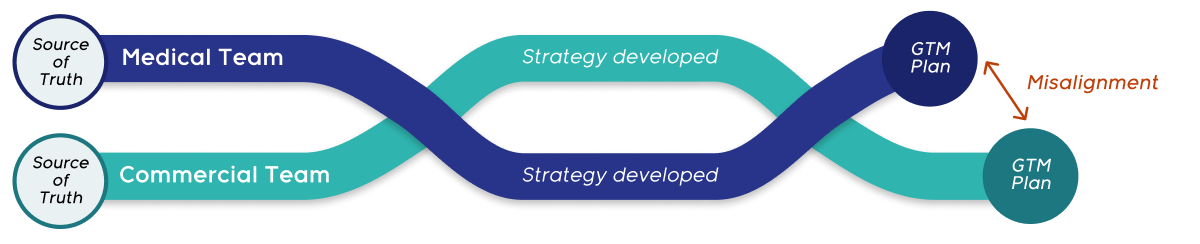
Separation by Design, Misalignment by Default
Across Pharma organizations, separation between Medical and Commercial functions is not only intentional, but necessary. It protects scientific integrity, ensures patient safety and maintains regulatory compliance. While the need for this structure is clear, issues often arise when compliance-driven separation is mistaken for a requirement to operate without shared direction.
Compliance principles define what can be said, when it can be said and by whom. They do not, however, define strategic direction. Over time, structural separation can evolve into siloed strategy formation with Medical and Commercial teams solving different problems, on different timelines, using different definitions of success.
Medical teams focus on disease dynamics, evidence needs and establishing scientific credibility. The core question becomes: what does the science allow us to say? Commercial teams focus on launch windows, differentiation, and driving brand choice. Their question becomes: how do we win in the context of the evolving market landscape?
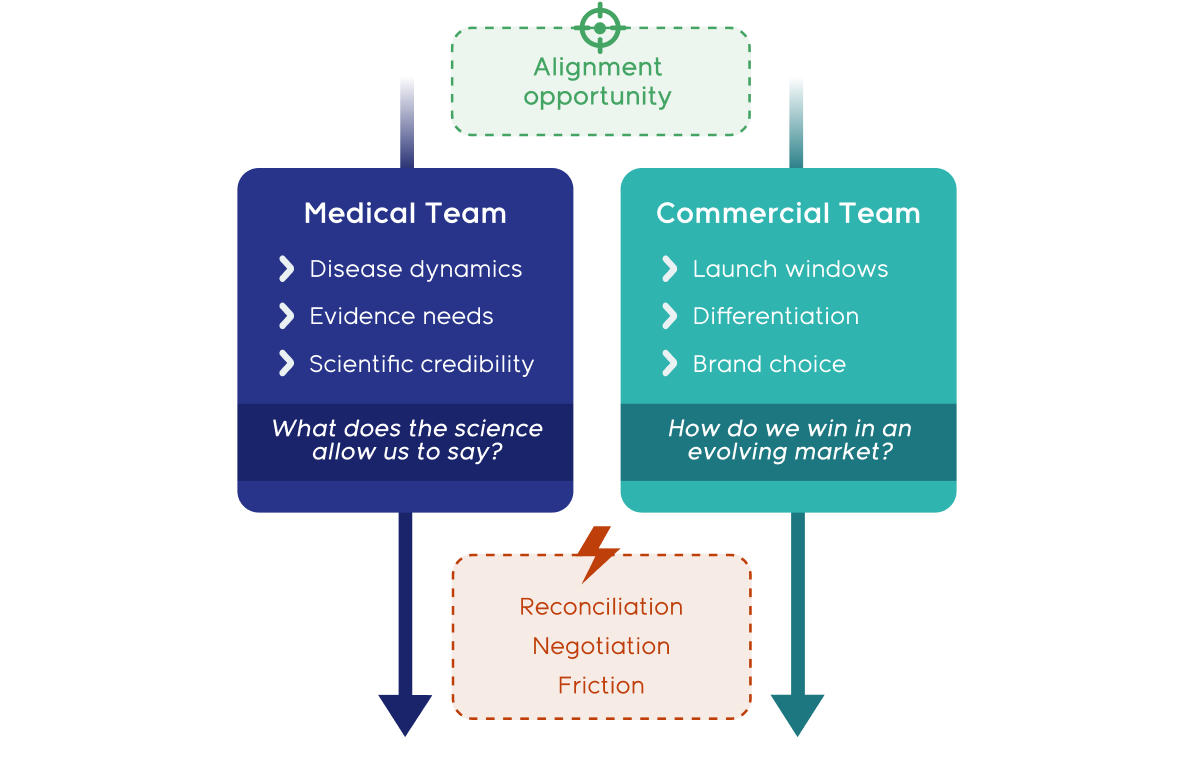
As a result, alignment efforts tend to focus on coordination rather than strategy design upfront. Organizations still run two GTM motions for the same asset, then attempt to align them later through cross-functional discussions and workshops. By that point, alignment becomes a negotiation, and the need for reconciliation across the two plans can introduce friction as teams are working toward goals that were never designed to converge.
The Missing North Star: A Shared Understanding of Patient Unmet Need
At the center of most Medical-Commercial misalignment is the absence of a shared strategic truth around patient unmet need. Too often, patient unmet need is treated as an input into strategy rather than its foundation. As that need evolves, Medical and Commercial teams interpret its implications differently, reinforcing divergence that coordination alone is unlikely to resolve.
So, what does alignment around a shared patient unmet need actually look like, given the compliance constraints that shape how Medical and Commercial operate?
Importantly, it does not require teams to engage in brand-focused discussions too early. At this stage, teams need to align on a direction to guide planning momentum with a shared understanding of where they are heading. While pre-launch constraints rightly limit what can be said about the brand, alignment can and should be achieved around which patient unmet needs matter most, how those needs could evolve over time, and what meaningful success looks like for patients and clinicians.
Patient unmet need provides a compliance-friendly anchor that allows teams to move in the same direction, even if they take different paths. Medical unbranded scientific shaping builds awareness that unmet need exists. Commercial market shaping later defines why that need matters now and why an asset is relevant in that context. When grounded in a shared understanding of patient unmet need, these efforts reinforce each other. When they are not, unbranded education can set expectations that the brand struggles to fulfil, or Commercial considers brand claims that extend beyond what Medical is comfortable defending.
How Separate Shaping Strategies Play Out Externally
What is at stake when Medical-Commercial alignment is missing and teams build go-to-market strategy in parallel rather than around a shared direction?
The answer lies in how scientific credibility and commercial choice are linked, rather than developed independently and stitched together later.
When credibility and choice are developed separately, HCPs, payers, and patients are left to connect the dots. This introduces variability in how value is understood across settings and stakeholders, often resulting in slower decision-making and more cautious adoption. For example, disease education may elevate a broad unmet need while the approved brand addresses a narrower clinical role, leaving clinicians to reconcile how the science translates into treatment choice. Over time, the onus shifts to the market and stakeholder community to absorb complexity created by parallel shaping, turning a strategy design misstep into a market-facing constraint on the impact the asset can ultimately deliver.
One Asset Requires One GTM Vision
A cohesive GTM vision is not an output of alignment. It is how our shared understanding of patient unmet need is translated into coordinated Medical and Commercial strategy over time. GTM strategy is then the means through which that vision is delivered and evolved and requires explicit agreement on how patient unmet need is understood, how it’s likely to change and how shaping efforts across Medical and Commercial should be sequenced (within compliant boundaries) as a result.
Because patient unmet need, evidence and market context evolve, our GTM strategy cannot be treated as a static launch deliverable. GTM strategy should be considered a living system designed to adapt as evidence matures and market dynamics evolve. Designing for evolution upfront is a leadership responsibility rather than something that can be corrected through alignment reviews once the strategies are already mapped out.
When a single GTM vision is clearly defined, it does more than create external coherence. It also changes how teams experience the work internally. Medical and Commercial operate as part of the same team under a shared direction, even within compliant separation. Decision-making becomes more straightforward, collaborative and less defensive, reducing the need to second-guess intent and enabling faster progress against the strategy.
An asset ultimately enters the market as a single proposition, experienced by patients through one journey, and is interpreted by stakeholders as one story. The question, then, is not simply how to to achieve Medical-Commercial alignment, but whether organizations are willing to make an earlier, more deliberate choice around how GTM strategy is formed, by designing it around a single shared truth from the outset.
For further perspective on designing cohesive, compliant go-to-market strategies and strengthening Medical-Commercial alignment in practice, review our GTM Excellence Platform or reach out to our team to discuss any support needs.
You can also catch our on-demand webinar, Redefining GTM Success: Balancing Near-Term Launch Priorities With a 10-Year Asset Vision, where we explore GTM success – how it is still too often judged by short-term launch performance alone – and why pharma teams need to reframe GTM success through a longer-term lens.