Most organizations have developed rigorous approaches for evaluating future indications. Commercial potential, development feasibility, competitive dynamics, and sequencing considerations are often assessed in considerable detail. Yet when discussions move beyond indication expansion, the process often becomes far less structured, despite the fact that indication expansion is only one of many ways an asset can create value over time.
After launch, as attention turns to the ticking lifecycle clock, many questions are frequently explored independently, such as:
- Could we strengthen adoption within existing populations?
- Could we improve persistence or adherence?
- Could we evolve how or where our therapy is delivered?
Too often, these questions are not proactively evaluated as part of an intentionally designed lifecycle pathway. As a result, organizations may inadvertently overlook opportunities that have the potential to create as much (or even more) long-term value than a future indication expansion.
As part of this series on early lifecycle management, we have explored how lifecycle pathways provide a structured way to think about long-term asset value creation. We also discussed how indication expansion often serves as one of the most important value creation milestones within those pathways, particularly when indication sequencing has been throughly considered and intentionally designed. Now, we take a look at how we can go beyond indication expansion to maximize an asset’s value.
Looking Beyond “What Indication Comes Next?”
One reason lifecycle growth opportunities beyond indication expansion are often evaluated inconsistently is that they serve very different purposes within a lifecycle pathway.
Some seek to expand the overall opportunity available to an asset. Others aim to increase utilization within existing populations. Others focus on reinforcing long-term value durability. Without a structured way to categorize these opportunities, it can be difficult to compare them, prioritize them, and understand how they contribute to the broader lifecycle pathway. The result is that organizations often compare fundamentally different opportunities against one another without first understanding the role each is intended to play within the broader lifecycle pathway.
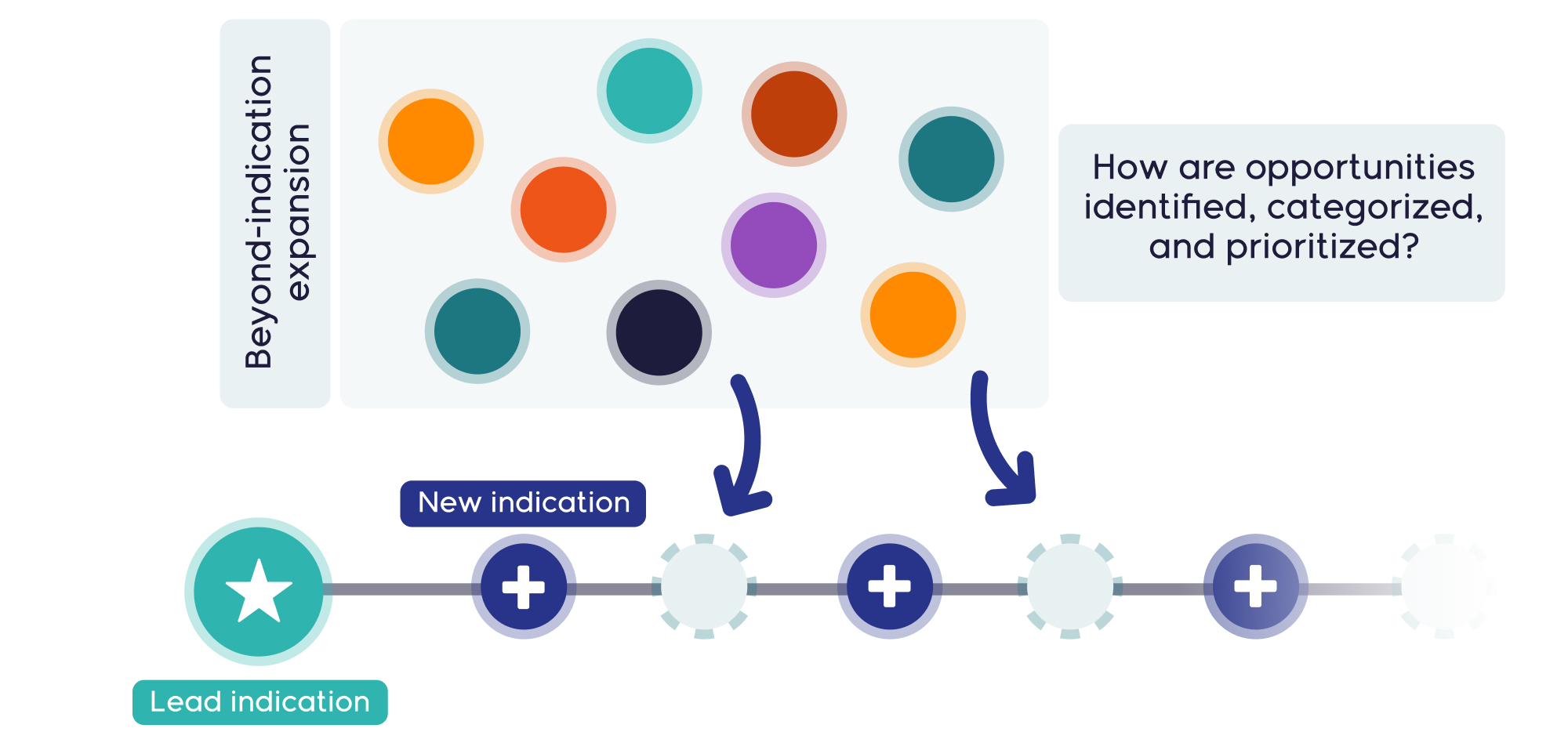
One useful way to address this challenge is to first consider the growth objective an opportunity is intended to support. As discussed in our previous article on the Breadth, Depth, and Sustainability Lifecycle Management Framework, lifecycle pathways can pursue very different balances of core growth objectives.
At the highest level, lifecycle growth opportunities can be grouped according to the objective they are intended to support.
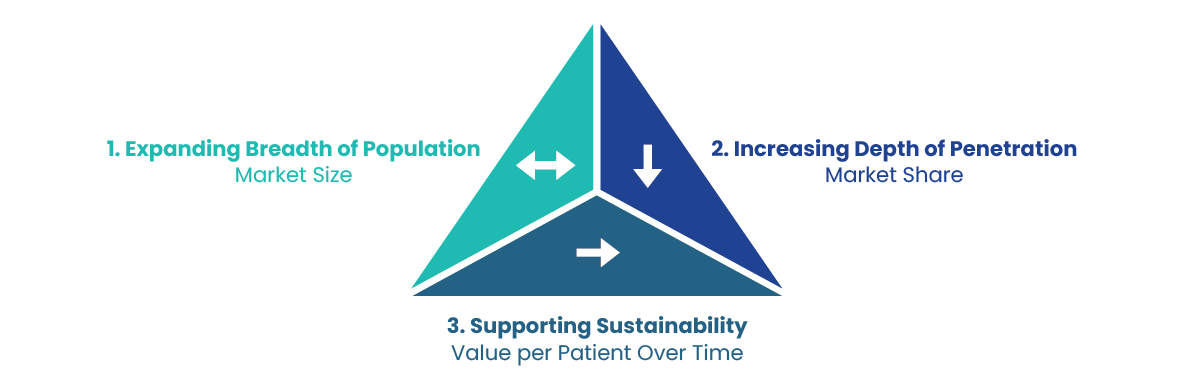
Breadth
Breadth is often reduced to indication expansion alone. In reality, market expansion may be activated through a much broader set of strategic levers, including:
- New patient populations
- Earlier treatment paradigms
- Expanded diagnosed patient pools
- Broader geographies
- Additional treatment settings
Depth
Depth is often approached primarily through positioning and promotion. But increasing adoption within eligible patients may also depend on factors such as:
- Stronger clinical confidence
- Improved guideline positioning
- Reduced prescribing hurdles
Sustainability
Sustainability is often viewed largely through the lens of persistence and drop-off. But long-term value durability may also be shaped by:
- Improving adherence
- Reducing real-world treatment burden
- Supporting long-term patient and physician confidence
- Evolving the treatment experience over time
Importantly, these lifecycle growth opportunities are not mutually exclusive. A single initiative may contribute to multiple objectives simultaneously. Understanding the objective an opportunity supports is therefore only the first step. Organizations must also understand the strategic levers available to unlock those growth opportunities.
Looking Across Strategic Levers
Lifecycle growth opportunities define where lifecycle value may come from. But teams also need a more systematic way to evaluate how those growth opportunities might be activated.
The reality is that lifecycle growth opportunities can originate from many different sources. Some involve changes to the label itself. Others depend on new evidence generation, improvements in product design, or changes to the broader healthcare ecosystem. Without a structured way to explore these potential growth opportunities, organizations risk focusing on the most obvious opportunities while overlooking others that could otherwise play a critical role within the asset’s lifecycle pathway.
Lifecycle opportunities can be structured across four broad categories of strategic levers – Align Strategy’s LEPS framework.
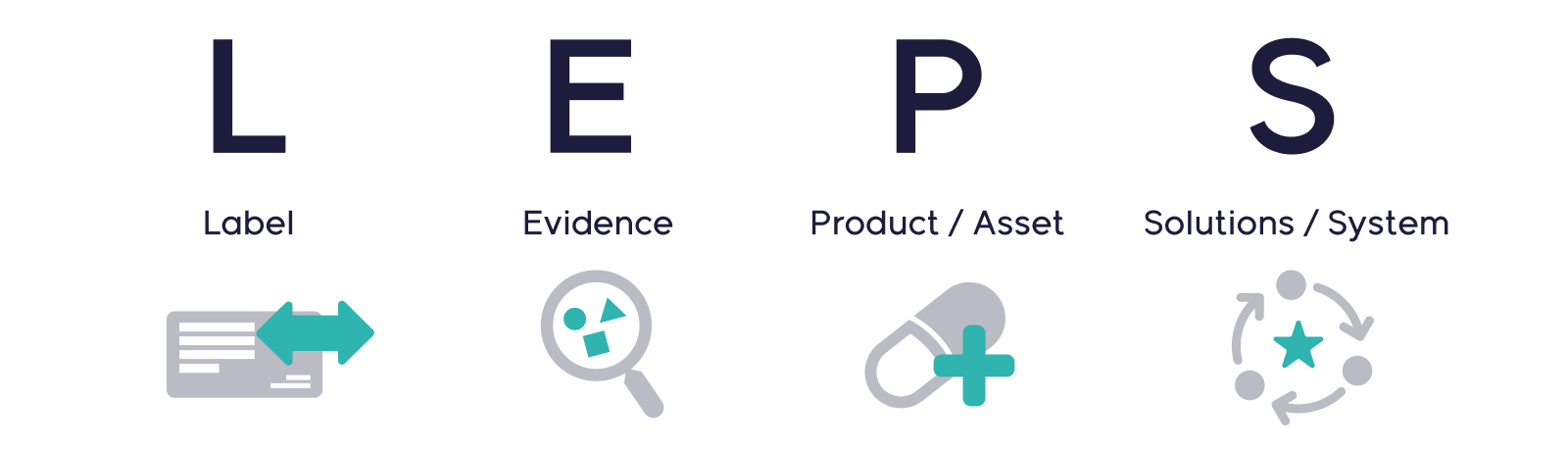
- Label – expanding or repositioning clinical use
- Evidence – strengthening confidence, differentiation, and proof
- Product / Asset Evolution – optimizing formulation, dosing, or administration experience
- Solutions / System – evolving the surrounding diagnostic, delivery, or care ecosystem
Importantly, these are not intended to function as tactical checklists or organizational silos. Rather, they represent categories of strategic levers through which lifecycle growth opportunities can be enabled. And critically, the same lifecycle growth opportunity may often be activated through multiple strategic levers simultaneously.
For example, expanding the treated patient population may be pursued through:
- A label shift into earlier-line use
- Improved diagnostic identification
- Reduced payer barriers
- A more convenient administration profile
- Evolution in site of care
The reverse is often true as well. A single strategic lever may contribute to multiple lifecycle objectives simultaneously. For example, a shift from reactive treatment toward prophylactic use may not only expand utilization within a disease area (Breadth), but also reinforce longer-term treatment durability and persistence (Sustainability). Some of the most powerful strategic levers are therefore those that create value across multiple dimensions at once.
Each lever influences growth differently. The challenge is therefore not simply identifying opportunities within each category, but understanding which combination of strategic levers is most likely to reinforce the broader lifecycle pathway.
Some of the Most Valuable Opportunities Hide Outside the Label
The purpose of a framework such as LEPS is not simply to generate more ideas. It is to broaden the range of opportunities considered when designing a lifecycle pathway. In practice, some of the most commercially meaningful lifecycle opportunities emerge outside the traditional “what indication comes next?” conversation.
A therapy shifting from reactive use into prophylactic use may dramatically alter utilization dynamics without changing disease area. For example, VONVENDI was initially approved for on-demand and perioperative use in adults with von Willebrand Disease before later expanding into broader routine prophylactic use, fundamentally evolving how the therapy could be used within the same disease setting.
Improved diagnostic infrastructure may unlock more growth than broadening formal eligibility criteria alone. The increasing standardization of biomarker testing in areas such as EGFR-mutated non-small cell lung cancer fundamentally expanded the ability to identify eligible patients for targeted therapies in routine clinical practice.
Evolution in treatment delivery and administration may materially expand practical feasibility of treatment. Industry-wide efforts to evolve infusion therapies such as Entyvio, Ocrevus, and Darzalex into more convenient subcutaneous formulations reflect the growing strategic importance of reducing administration burden, increasing delivery flexibility, and sustaining long-term utilization in increasingly competitive markets.
In some cases, improving the treatment experience may extend beyond the therapy itself. During the COVID-19 pandemic, Moderna collaborated with Uber to help raise vaccine awareness and reduce transportation barriers to vaccination, illustrating how practical obstacles outside the product itself can meaningfully influence healthcare engagement and utilization. An example of a lifecycle solution that goes beyond the obvious options, it serves as a useful reminder that some of the most impactful growth opportunities may emerge from addressing obstacles that exist beyond the product itself.
None of these opportunities diminish the importance of indication expansion, which remains one of the industry’s most important lifecycle tools. But they do reinforce a broader reality: some of the most meaningful sources of lifecycle value may emerge beyond the traditional next-indication conversation.
Expanding the Lifecycle Lens for Better Pathway Design
Effective lifecycle planning requires more than identifying the next indication. It requires a structured approach to identifying, evaluating, and prioritizing a broader range of lifecycle growth opportunities based on the objectives the asset is seeking to achieve, while looking beyond isolated initiatives to understand how different strategic levers may collectively contribute to the broader lifecycle pathway.
The companies that create the most durable asset value over the next decade are unlikely to be only those that simply pursue the greatest number of indications. They will include the ones that look beyond indication expansion to evaluate lifecycle growth more multidimensionally, explore a broader range of strategic levers, and intentionally design pathways where multiple sources of value reinforce one another, compound value over time, and collectively shape the long-term trajectory of the asset.
If you are currently evaluating early lifecycle management priorities or broader lifecycle expansion opportunities, we would welcome the opportunity to discuss how a more systematic evaluation approach may help uncover under-explored growth levers for your organization – please reach out to us here.