In pharmaceutical go-to-market (GTM) and launch planning, confidence can often be mistaken for certainty. Having robust forecasts and a clearly articulated brand strategy can create an illusion of control. Yet, one only has to look back at how some of the biggest global brands (inside and outside of pharma) have failed, to see that some of the most damaging missteps commercial teams can make arise from not preparing for how uncertainties may unfold.
An example of this is in what was once one of the biggest brands in the film and photography industry: KODAK. Whilst KODAK invented the world’s first digital camera in 1975, the company chose not to market it, fearing it would cannibalize its lucrative film business. Digital cameras became mainstream in the 2000s, and competitors like CANON and SONY captured the market. Subsequently, KODAK went from being a market leader to filing for bankruptcy in 2012.
What was KODAK’s mistake? The explosion of the digital photography revolution was an uncertainty that KODAK did not plan and prepare for.
Back in the world of pharma, we operate in an industry that is evolving at an unprecedented pace, characterized by intensifying scientific complexity, increasing regulatory scrutiny, greater diversity in the competitor sphere, and geopolitical and economic volatility that is creating new headlines seemingly daily. In this environment, uncertainty cannot be a peripheral consideration in GTM planning. It must be a defining feature of the context in which pharma brands are born, grow and live.
Companies that position themselves for success are not those that attempt to predict the future most accurately, but those that plan for uncertainty most deliberately.
Incorporating uncertainty and risk planning early in the process fundamentally strengthens go-to-market strategy. It enables teams to define their base‑case assumption of what the most likely future looks like, prioritize the variables that truly matter, enables proactive market shaping, and ensures teams are prepared and ready to pivot when current assumptions no longer ring true. Crucially, robust uncertainty and risk planning prevents costly missteps that can occur when GTM plans are built on a single view of the future.
Uncertainty is Not an Enemy of Strategy, But Not Planning for it is
In pharma, uncertainty planning is often sidelined or deferred in favour of other demands which can be perceived as higher priority. This mindset prevails as launch teams are under increasing pressure to align on a clear direction, with leadership teams that want conviction. In this context, ambiguity can feel unsettling and at odds with team goals. However, deprioritising uncertainty does not make it disappear, it just means that should events play out in a way that has not been planned for, teams are less equipped to course-correct.
Uncertainty vs. Risk
When planning for uncertainty, it is important to distinguish uncertainty from risk. Uncertainty reflects future events where outcomes are unknown and probabilities of outcomes occurring cannot be quantified, such as competitor trial readouts, evolving standards of care, changes in payer behaviour, or regulatory expectations. Risks, however, represent potential outcomes of an uncertainty that could have a negative impact. In the context of a base-case assumption, risks represent alternative (negative) outcome(s) to the base-case outcome.
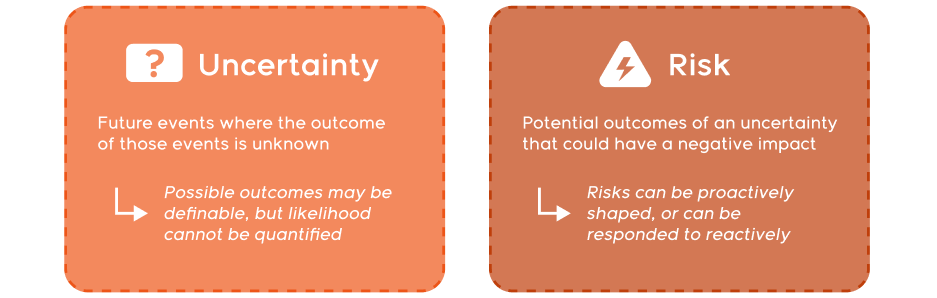
The implication of this delineation is meaningful, because without first articulating a base‑case outcome of an uncertainty, there is no baseline against which risks can be meaningfully identified, compared, or managed.
Early uncertainty planning is not about building multiple contingency strategies from day 1. It is about systematically surfacing what is unknown, defining the most likely outcome of those unknowns, stress‑testing how else those unknowns may play out, and planning for them.
A final point on uncertainty before diving into the practicalities of early uncertainty and risk planning. Uncertainty planning does not only enable you to identify risks and downsides, but they also highlight where your opportunities are. So, by not planning for them, not only are companies neglecting to safeguard against potential risks, they are also missing potential valuable opportunities to double-down on their success.
Strengthening Strategy Through Robust Base‑case Development
Every GTM plan must be rooted in a base-case strategy: assumptions about what is most likely to happen in relation to elements such as the label, treatment adoption and uptake, access, competitor activity, and market evolution. A base-case assumption must be developed for these elements because before they happen, we do not know with certainty what they will be. These elements are unearthed via uncertainty mapping.
Uncertainty Mapping
Uncertainty mapping, which should be embedded within your situational analysis, helps teams to confront the full range of plausible future outcomes. By examining internal (uncertainties that exist within a company), market (uncertainties created by activity in the market), and competitive (uncertainties created by competitor activity) uncertainties across near‑, mid‑, and long‑term horizons, teams can articulate a base‑case assumption that is not about what is aspirational, but about what is realistic and credible.
This discipline strengthens strategy in two ways:
- Firstly, it anchors strategic choices in realism. Strategic imperatives, positioning, tactics all become aligned to what is most likely to happen, not what teams hope will happen.
- Secondly, it clarifies what differentiates the base‑case from alternative futures. That clarity becomes invaluable when the environment around us moves.
A robust base‑case is also not static. It is a living, breathing reference point against which risks, opportunities, and scenarios are continuously assessed.
Risk Prioritization: Focusing Attention and Resource Where it Matters Most
A common pitfall in GTM strategy is spreading attention and resource too thinly across a long list of potential risks. Not all risks deserve equal focus, because 1) not all risks represent the same level of threat, and 2) not all can be actively managed or influenced.
Risk prioritization provides a structured approach to help teams focus attention where it is needed most. By systematically assessing risks based on likelihood, business impact, and the company’s ability to influence or mitigate outcomes, teams can focus resources where they will have the greatest strategic return on investment.
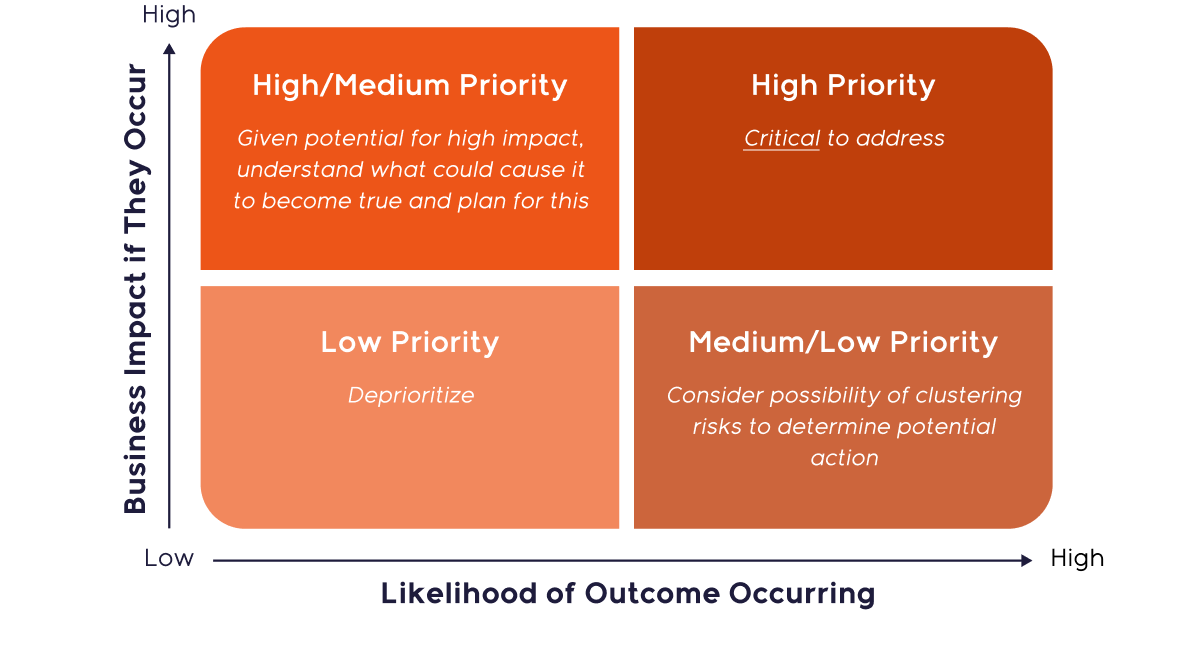
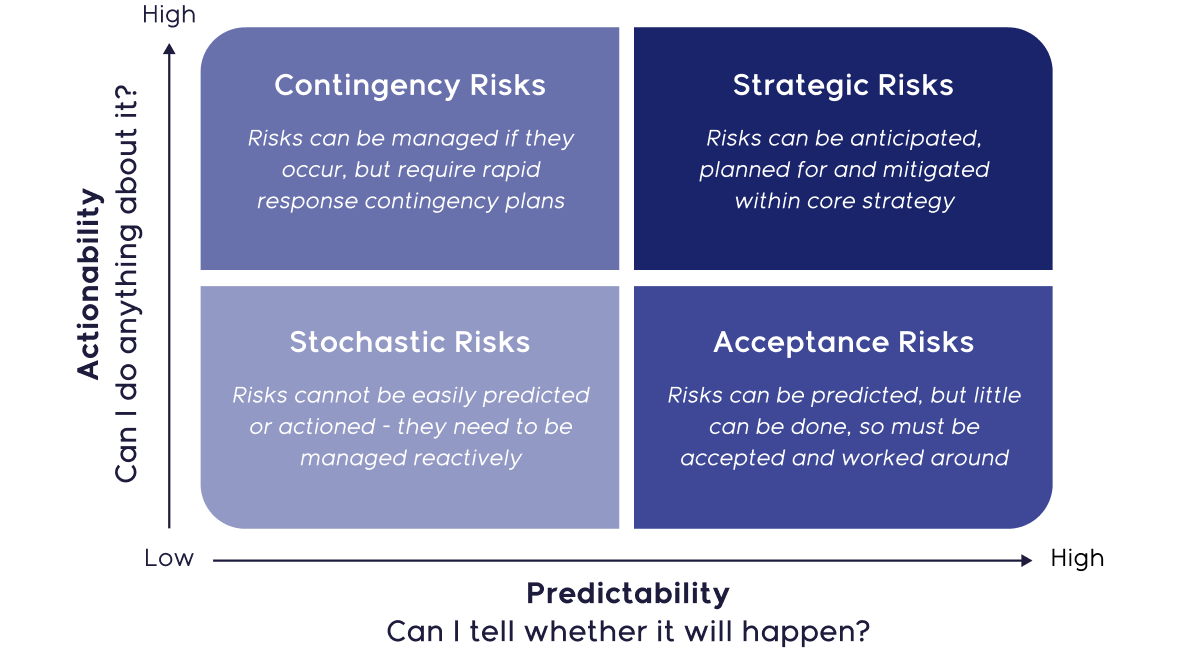
- High‑impact risks that can be shaped and mitigated become focal points for proactive action
- High‑impact risks with limited actionability can be accepted, monitored and reacted to when necessary, rather than distorting core strategy
- Low‑probability, low‑impact risks can be deprioritized
This process ensures we are proactive where we need to be, and reactive where we need to be.
Scenario Planning: Managing Complexity Without the ‘Analysis-Paralysis’
As uncertainty compounds, particularly when it comes to mid-long-term uncertainties where the number of potential outcomes and risks become greater, individual risk assessment becomes inadequate. This is where scenario planning adds value.
Rather than attempting to plan for every possible permutation of uncertainty, scenario planning consolidates multiple unknowns into a more manageable number of thematic, plausible future worlds. Each scenario represents a fundamentally different context within which the brand might need to compete, each with distinctly different implications.
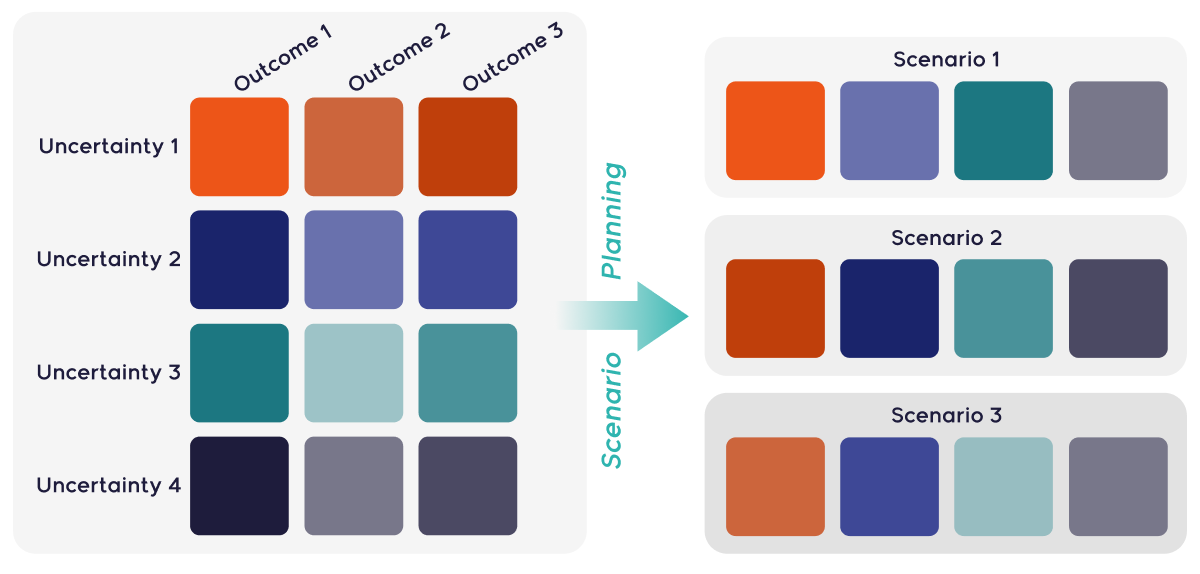
The power of scenario planning lies not in prediction, but in preparation. By exploring how stakeholder behaviour, treatment algorithms, access dynamics, and competitive intensity could evolve under different conditions, teams can identify strategic elements that are robust across all futures vs. those that are scenario‑dependent.
There must be a plan in place to reshape and/or re-focus strategy across each scenario, meaning that whichever scenario becomes reality, teams are ready to adapt accordingly.
Proactive Market Shaping as a Strategic Risk Response
Through the lens of early uncertainty and risk planning, market shaping transforms from being a downstream executional activity to a core strategic lever.
For risks that are likely to happen, highly impactful to the business, but not fully controllable (such as evolving payer definitions of value, guideline changes, or competitor narrative shifts), market shaping becomes a critical means of influence. Evidence generation strategies, disease education, and stakeholder engagement can all be deployed to influence the market discourse in your favor.
Crucially, market shaping is most effective when initiated early. Waiting until uncertainties materialize often means reacting within constraints that have already been set by others. By contrast, early alignment between uncertainties and market shaping priorities helps companies to define the shape of the playing field rather than simply playing on it. This means that the risks that were previously identified as not fully controllable can be influenced before they occur.
Contingency Planning
Not all risks can or should be shaped. Some risks will be high impact, but with a low probability and actionability, and therefore require preparedness rather than prevention.
Contingency planning ensures that when such events occur, be that unexpected regulatory decisions, disruptive competitor data or sudden policy shifts, teams are not starting from zero. Pre‑defined triggers, messaging frameworks, and executional activities enable a rapid, coordinated response.
Importantly, contingency plans should not distract from executing the base‑case strategy. They exist in the back pocket of your GTM plan, activated only when pre-defined signals emerge. This preserves strategic focus whilst maintaining the team’s agility.
Continuous Monitoring: Building Your Early‑warning System
The value of uncertainty planning is augmented with continuous, targeted monitoring. Rather than tracking everything, high‑performing teams identify the specific signals that indicate whether assumptions are holding or eroding, and they prioritize those signals for monitoring.
Competitor milestones, regulatory guidance, guideline updates, policy changes, and shifts in clinical practice can all serve as early indicators that the market is straying from your base-case assumption. When these signals are monitored with clear cadence and ownership, teams can gain precious time to adapt.
Monitoring also creates a bridge between strategy and reality. It ensures that GTM plans evolve with the market, rather than being rewritten only after performance deviates from what was expected.
Preventing Missteps and Building Credibility
Perhaps the most underemphasized benefit of early uncertainty and risk planning is how it builds credibility. Leaders, investors, and cross‑functional partners are more likely to buy into and trust strategies that acknowledge uncertainty and articulate clear plans for managing it.
Missteps often occur not because teams were unaware of uncertainty, but because it was never explicitly discussed, prioritized, or owned.
By integrating uncertainty into the fabric of GTM planning, from situational analysis through to execution, teams replace fragile confidence with strategic resilience.
In an industry where the stakes are high and the future doesn’t always play out as expected, this resilience is a competitive advantage.
The Strategic Imperative of GTM Planning
The aim of uncertainty management in GTM planning is not to eliminate uncertainty, but to integrate it. Embracing and incorporating early uncertainty and risk planning strengthens your base‑case strategy, sharpens risk prioritization, enables proactive market shaping, and ensures readiness for disruption. Above all, it prevents companies from being caught off guard by futures they could (and should) have anticipated.
Don’t let uncertainty management be a flaw in your GTM plans to be corrected later. Make it a strategic input to be embraced from the very beginning.
Explore Align Strategy’s Go-to-Market Excellence Platform to learn how our team of experts can help you better navigate uncertainties and risk as you bring your asset to market.
Catch our on-demand webinar, Redefining GTM Success: Balancing Near-Term Launch Priorities With a 10-Year Asset Vision, where we explore GTM success – how it is still too often judged by short-term launch performance alone – and why pharma teams need to reframe GTM success through a longer-term lens.