Competitive strategy is rarely missing from pharmaceutical launch planning. In the 12 to 18 months before approval, few brand teams would finalize positioning, messaging or launch plans without a clear view of how competitors and stakeholders are likely to respond. The same rigor isn’t always applied to the competitive landscape years earlier, when the decisions that shape an asset’s competitive potential are still being made, and are gradually being locked in.
Yet for early-stage pharma assets, competitive strategy is an essential input into both go-to-market strategy and early lifecycle management. It informs:
- Which indication to lead with and how to sequence the rest
- How pivotal trials are designed, from population and comparator to endpoints
- Which evidence is generated for payers and physicians
- How the asset will ultimately be positioned and messaged
- How the asset is formulated and delivered
By the time launch planning begins, many of these choices are already fixed, and with them the ceiling on how far the asset can differentiate.
As we look across the industry, the pattern is consistent: the assets that go on to lead a category, rather than fade after approval, tend to share one discipline: early competitive strategy that plans for the competitive landscape at two distinct timepoints – launch, and what comes after.
Two competitive time horizons, two sets of strategic questions
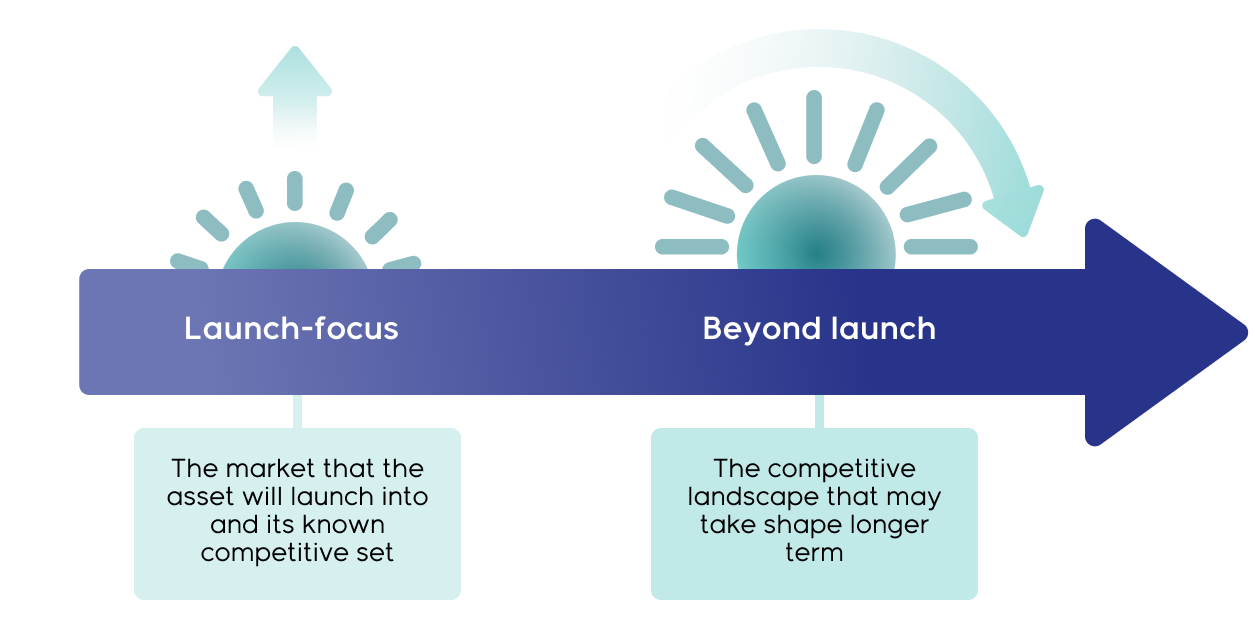
At its best, early competitive strategy plans for two time horizons together: the market the asset will launch into, and the market that evolves following launch. The competitive dynamics at each point are rarely the same: new entrants arrive, the standard of care shifts and stakeholder expectations rise. As a result, each timepoint calls for its own strategic questions.
Near- to mid-term – Launch focus
In the near- to mid-term, the focus is on the market that the asset will launch into and its known competitive set: how established and late-stage competitors are likely to be positioned when the asset arrives, what data or label claims they will differentiate on, and what bar that sets for the asset’s own profile. This is about making sure today’s development decisions give the asset a credible, differentiated position on day one.
Strategic questions:
- What are our competitors saying and doing to drive use of their product?
- What will competitors do and say ahead of our launch?
- What data or label claims will they differentiate on?
- What profile do we need to stand out on day one?
Longer-term – Beyond launch focus
Here the focus shifts from who the near-term competitors are to how the competitive landscape may take shape: which modalities and mechanisms are emerging, how the standard of care could change, what are today’s competitors heading next, and how payer and physician expectations may rise. As this timepoint is further away and has more uncertainty, it can be easier to overlook, but it determines what the asset will ultimately need to do to sustain or evolve its position in the longer-term competitive landscape.
Strategic questions:
- Where could the standard of care be heading, e.g. with biomarker or combination approaches?
- Which new mechanisms or modalities could change the basis of competition?
- Which expansion paths will today’s competitors pursue (e.g., new indications, earlier lines, new geographies, new formulations), and what might they deprioritize?
- How could stakeholder expectations rise as new treatment options arrive?
Holding both competitive horizons together
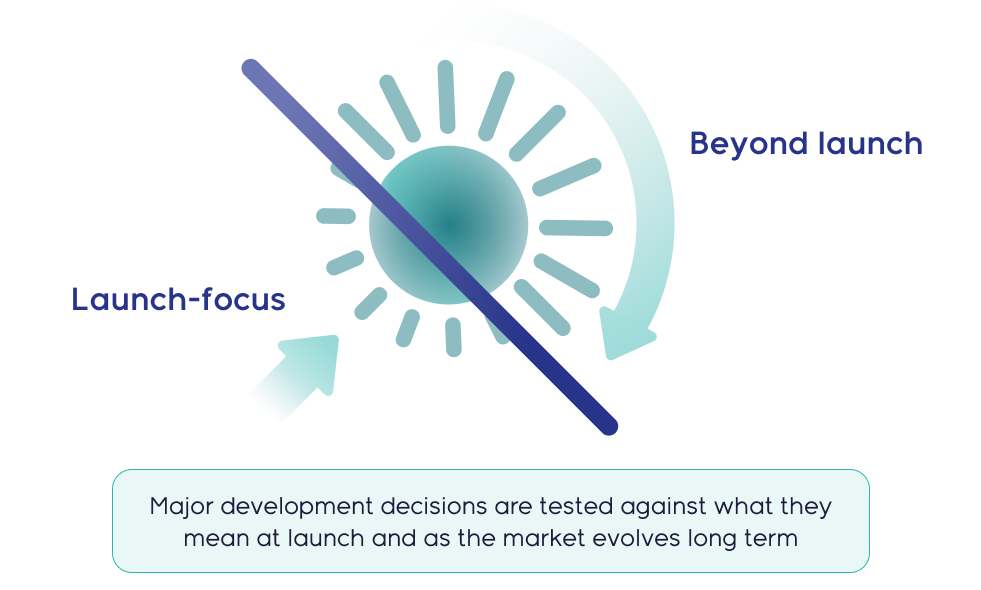
Teams under pressure to reach approval often default to considering only the near-term competitive horizon, optimizing for the competitors they can see. The stronger approach is to build a deliberate view of both competitive horizons and hold them together in strategic planning, so that each major development decision is tested against what it means at launch and for the asset’s role as the market evolves. Because the view beyond launch carries far more uncertainty, it cannot be treated as a single predicted future. It requires exploring a range of plausible futures and revisiting them as evidence emerges.
In practice, this can be built into early competitive strategy through four connected steps:
1. Map the competitive landscape across both horizons
Build a synthesized view of today’s market and how it could evolve, covering competitor pipelines and strategic intent, treatment paradigms and stakeholder dynamics, and surface the critical uncertainties that could most change the picture.
2. Develop focused, differentiated competitive scenarios
Translate those uncertainties into three or four distinct scenarios – plausible views of how the market could evolve beyond launch, each different enough to carry its own strategic implications. This pressure-tests what the future could realistically look like, and flags early what to watch.
3. Pressure-test the asset’s role
Define or refine the asset’s intended role (which patients, where in the treatment sequence, standalone or combination backbone, what evidence it will need) and pressure-test it against both the launch landscape and the future scenarios. This is where the two horizons are reconciled: choices that hold up across futures become core strategy, while others become contingent options.
4. Monitor signposts and adapt as the future takes shape
A role that holds up across scenarios builds resilience, but it doesn’t remove the need to evolve. As the market develops, elements of one or more scenarios will become clearer, and the asset strategy may need to adapt.
A practical monitoring framework tracks both external and internal signposts. External signals may include competitor trial readouts, pivotal trial initiations, indication expansions, new modalities, or policy shifts linked to the critical uncertainties. Internal signals may include the company’s own emerging clinical data, biomarker or diagnostic performance, and initial safety findings. Together, these signals help teams recognize when assumptions are shifting and when it is time to revisit the asset strategy or portfolio priorities.
Teams that define these triggers in advance are better positioned to respond with purpose, rather than waiting until a change becomes unavoidable.
Early competitive strategy in action: Lessons from Dupixent & Keytruda
Two of the industry’s most successful drugs show what this looks like in practice. In each case, launch was shaped by a clear read of the known competitive set, while early development choices also set the asset up for how the market would evolve. The lessons they provide are different: one is about indication sequencing strategy, and the other about strategic trial design, but both show how embedding competitive strategy early on can create a lasting advantage.
Dupixent (dupilumab): Building breadth from the start
Dupixent is one of the world’s best-selling drugs, yet its most obvious market was one where it would have been fourth to market. Early in development, severe asthma looked like the natural path, but several anti-IL-5 biologics were already ahead. The view at launch was clear: following that route meant competing as a late follower, on terms the incumbents had already set.
Looking beyond launch revealed a different option. Dupixent’s mechanism, blocking IL-4 and IL-13, targets biology shared across a family of type 2 inflammatory diseases, many of which occur together in the same patients. That opened a different question: not where the asset could enter, but where it could lead. For launch, they prioritized atopic dermatitis, where no biologic existed, giving the asset a clear, differentiated first position. Beyond launch, they ran programs in asthma, nasal polyps and eosinophilic esophagitis in parallel rather than one after another.
Each approval strengthened the next. More specialists gained experience with the same drug, and patients with multiple conditions could be treated with one therapy. In 2024, Dupixent became the first biologic approved in COPD. Competitors built around a single disease could expand, but not as fast or as coherently, and Dupixent became the reference point in type 2 inflammation. The mechanism created the opportunity; competitive strategy across both horizons turned it into a lasting lead.
Keytruda (pembrolizumab): A different route to the same competitive advantage
Where Dupixent built breadth from the start, Keytruda shows that a deliberately narrow start can be just as powerful when it sits within a longer-term plan. In first-line advanced non-small cell lung cancer (NSCLC), BMS pursued breadth with Opdivo (nivolumab): its CheckMate-026 trial enrolled patients with PD-L1 expression of 1% or more to maximize the eligible market. Merck narrowed its focus: KEYNOTE-024 enrolled only patients with PD-L1 expression of 50% or more, roughly a third of those screened, and Merck developed and validated its own companion diagnostic (the 22C3 test) alongside the clinical program.
At launch, the choice paid off. CheckMate-026 missed its primary endpoint for progression-free survival, while KEYNOTE-024 succeeded on both progression-free and overall survival, and Keytruda became the first immunotherapy approved as a standalone first-line treatment for high-PD-L1 NSCLC.
Beyond launch, that narrow population proved to be the first step in a deliberately sequenced plan:
- Establish the reference point. Because the 22C3 test was built into the pathway from the start, PD-L1 testing became routine in lung cancer diagnosis, and competitors had to position themselves against Keytruda’s data and diagnostic standard.
- Keep parallel options open. While KEYNOTE-024 was running, combination studies with chemotherapy were also underway, extending Keytruda’s first-line use to patients regardless of PD-L1 level in both non-squamous and squamous disease, and turning a biomarker-defined niche into the backbone of first-line care.
- Move earlier in the disease. Merck then moved into adjuvant and perioperative settings in early-stage lung cancer, extending the asset’s role across the patient journey.
- Evolve the format. In 2025, Merck brought a subcutaneous formulation to approval, giving patients and providers a faster way to receive treatment as the brand enters its next chapter.
Competitors responded strongly, with BMS rebuilding through combination regimens and securing the first neoadjuvant indication in early-stage NSCLC. But the position Keytruda established early compounded across more than 40 indications, and by 2025 it was the world’s best-selling drug, with sales of $31.7 billion.
In both examples, what made the difference was not the specific choice, but the competitive thinking across both horizons behind it.
Turning foresight into decision-making: commitment, optionality, and the need for alignment
Knowing what each competitive horizon will look like is only half the task. The hardest part is deciding what to do about it, because the two timepoints call for different kinds of decisions:
- For the launch horizon, the competitive set is largely known, so teams need to make clear bets: commit to the indication, population, comparator and evidence choices that will give the asset a differentiated position on day one.
- Beyond launch, there is too much uncertainty to commit with the same confidence. Here, the aim is to build optionality into the asset’s plan, so that teams can take the best path as the competitive landscape becomes clearer.
Translating competitive foresight into concrete development and investment decisions is rarely simple, because each option a team might keep open comes with its own competitive trade-offs. Choosing an active comparator over placebo may raise the risk of trial failure; expanding into a harder-to-recruit population may delay readout. In each case, the cost is borne early, while the competitive benefit (a stronger label, a clearer position in the treatment sequence, harder-to-dislodge reference status) may not be visible for years.
This asymmetry can tempt teams to defer the harder choices. Not every strategic bet will pay off, but making the trade-offs explicit early on lets teams decide where optionality is worth the investment, and where speed, focus, or commitment should take priority instead. Commitment and optionality are not mutually exclusive: the aim is to preserve the choices that matter most for the asset’s competitive position while the team still has real influence over the development path.
Moreover, those choices also rarely sit within one function. Clinical development is measured on speed and probability of success. Market access teams need comparators and endpoints that support value and price. Commercial teams may seek a broad and defensible label. Medical affairs may be thinking about how the data will land with physicians. Each view is valid, but decisions made in isolation tend to optimize for one function’s goal, and often for one horizon, at the expense of the asset’s long-term position. Merck’s strategy with Keytruda only worked because clinical, diagnostic, medical, and commercial plans were designed in a coordinated way.
Competitive strategy for an early-stage asset has two jobs at once: informing the decisions that determine how the asset launches and informing the decisions that determine how it competes as the market evolves. Considering both together, and continuing to assess the strategy through a competitive lens as evidence emerges, is how early competitive strategy drives competitive differentiation and sets an asset up for success across its lifecycle. The earlier teams start, the more freedom they retain to shape the asset’s role; as development progresses, those choices become harder and more costly to revisit.
At Align Strategy, we ensure that key competitive questions are asked from the outset. We partner with teams to embed competitive strategy as a continuous discipline from early development through launch, ensuring optionality is preserved and your asset is positioned to withstand market development and uncertainties. Reach out today to learn more from our competitive strategy experts.

For more on how to effectively balance the launch and lifecycle horizons of an asset, watch our on-demand webinar: Design the Lifecycle Before it Designs Itself.